Exile
The Best Werewolf Short Stories 1800-1849Exile is not merely a change of residence in the book; it is a forced removal from protection, rank, memory, and belonging. It begins as a political sentence imposed through deception, becomes a life of hunger and concealment in the forest, and then reappears in family flight, inherited guilt, and the precarious refuge offered by strangers. Through Gaspar de Marcanville and Krantz’s family, exile turns the map of Europe into a moral landscape in which authority can expel a person while continuing to govern his fate.
Political Banishment and the Loss of Rank
Gaspar de Marcanville’s exile follows the treachery of De Saintefleur. When De Saintefleur draws his sword and cries “What, ho! guards! Treason!”, Gaspar is left immoveable with astonishment and horror. Francis is persuaded that Gaspar was guilty of the attack De Saintefleur himself had initiated. Gaspar’s silence deepens the injustice: he refuses to say anything that might incriminate his former friend, even when his own life and reputation are at stake. The King’s former favor does not disappear instantly, but court pressure finally forces Francis to impose degradation and banishment upon him. The sentence removes more than Gaspar’s physical presence from France. He is stripped of rank and sent away under an accusation he will not answer by betraying the man responsible. The political order therefore treats loyalty as evidence of guilt: Gaspar’s refusal to defend himself through denunciation helps preserve his moral integrity while allowing the court to expel him. His exile is an instance of power operating through exclusion, since the sovereign’s judgment determines both his public identity and the legal future of his family.
The Forest as Refuge and Prison
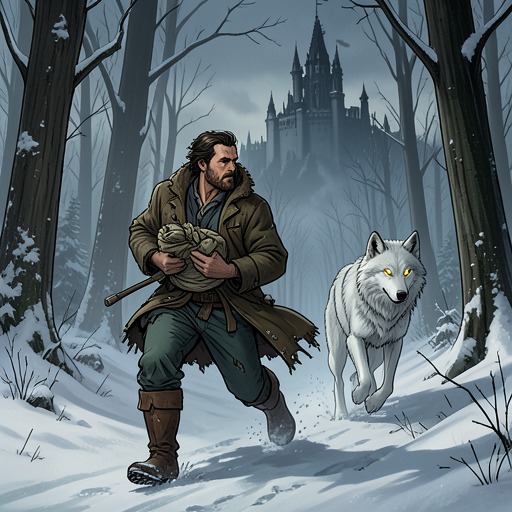
Gaspar hastens to his Chateau, but the treasures he is permitted to carry into exile are little more than Rosalie and his daughter Adéle. With them he retreats into the dark and almost boundless recesses of the Hanoverian Harz. His body changes under the pressure of flight, labor, and sorrow until his former appearance becomes altogether unknown. Exile thus produces a second disguise: the banished nobleman is gradually remade into an unrecognizable hunter. In the savage retirement, Gaspar writes a faithful account of De Saintefleur’s treachery and obtains a certificate from his Confessor, Father Ægidius, to confirm its truth. He directs the document to Francis and gives it to his wife, instructing her to deliver it if he dies during one of the dangerous expeditions by which the family survives. The document preserves a possible route back to rank and estates, but only after Gaspar’s pledge to De Saintefleur can no longer be claimed. Exile therefore suspends justice in time: truth is prepared for a future in which the injured man may be absent, dead, or no longer able to speak. Years in the Hercynian woods make Gaspar a capable hunter. His endurance is sustained not by hope for himself but by two remaining objects of attachment, Rosalie and Adéle. The wild-buck cannot escape his spear, and the bear is too weak to resist his attacks; these details turn the forest into both livelihood and ordeal. He has been removed from the social world, yet survival requires a relentless mastery of the natural one.
Return Deferred by Altered Identity
About ten years after Gaspar’s exile, Rosalie dies, leaving him a widower while Adéle is scarcely eighteen. Her death removes the domestic bond that had held him to the forest and drives him toward a dangerous decision. Gaspar resolves to return to France, approach the Court even though he has not been recalled, lay his papers at the foot of the throne, and demand the Ordeal of Combat with De Saintefleur. The attempt fails not because his claim has been disproved, but because daylight reveals what exile has done to him. In the woody Province of the Upper Limousin, he sees the changes wrought by ten years of severe labor and heartfelt sorrow. He could safely enter Francis’s Court insofar as personal recognition is concerned: the man who was once known there has vanished from his own face. Yet this protection is also another loss. The same transformation that allows him to pass unnoticed confirms that exile has erased his former social identity. Gaspar chooses instead to remain near St. Yrieux, where the surrounding forest can hide him in France without restoring him to society. Under the guise of a hunter, he can support Adéle; if he dies, she will be nearer to her sovereign’s residence. He uses part of his small remaining property to secure a residence in a dilapidated Chateau. His return is therefore geographical but not political. France becomes a place in which he may secretly live, not a community that has formally received him back.
Exile, Pursuit, and the Unprotected
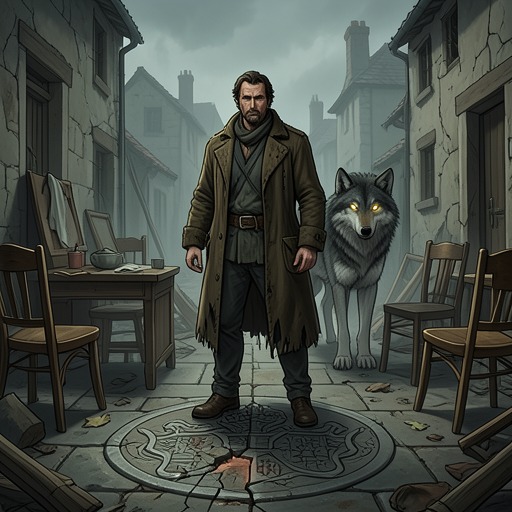
The later terror surrounding the woods of the Limousin gives Gaspar’s refuge an ominous setting. The inhabitants of St. Yrieux hear that a Wehr-Wolf, or perhaps a troop of them, inhabits the forest. Howlings disturb the night, and the wild rush of a chase passes through deserted streets. The townspeople fasten their windows more securely, regarding the window as the Wehr-Wolf’s usual entrance, and abandon those already taken by the monsters. Country people near the forest lose children whose lacerated remains are later found only half devoured. This communal response mirrors the logic of exile. Instead of confronting the danger collectively, the townspeople protect private thresholds and leave the exposed to their fate. The forest becomes a place where people can be hidden, hunted, or discarded, while the settled community preserves itself by withdrawal. Gaspar’s own concealment is therefore both safer and more precarious than belonging: the same distance from ordinary society that shelters him also places him within a landscape where abandoned victims disappear.
Earlier Flights and the Repetition of Dispossession
Krantz’s account reveals that exile is not confined to Gaspar’s political misfortune. His father was a serf of a powerful Hungarian nobleman in Transylvania, though wealth, intelligence, and respectability had raised him to stewardship. Serfdom nevertheless fixed his status: whoever was born a serf had to remain one. His legal identity overruled his abilities and prosperity, establishing the same contradiction that later governs Gaspar’s banishment—personal worth cannot protect a person from a system’s classification. Krantz’s father murders his wife and her seducer after discovering their intrigue. Knowing that a serf would not be allowed to plead even the provocation he had suffered as a justification, he gathers money, places his children in a sleigh, and flees in the depth of winter. He continues without intermission until the family is hidden in the Hartz Mountains, beyond the reach of authorities in their native country. The flight is therefore both escape and sentence: it saves the children from immediate pursuit, but it also uproots them and binds their future to a crime committed under unequal law. Another displaced family reaches the same mountains from the opposite direction. A hunter encounters a man on horseback with his daughter riding behind him; they have escaped from Transylvania because the daughter’s honor and the father’s life are equally threatened. The girl is chilled by the frost and near death, while the fugitives fear that concealment alone will not preserve them from hunger and the severity of the night. Krantz’s father recognizes his own escape in their plight, remembers the loss of his wife’s honor, and immediately offers the assistance he can provide. Exile here creates a painful chain of recognition: the persecuted can identify one another across different histories because each has learned what it means to be denied safety at home. The pattern reaches its bleakest form when the hunter Wilfred declares that Krantz’s father must pay the penalty attached to his marriage vow. After two children are gone, the third is still destined to follow, while the father himself is condemned to live. He leaves the cottage forever with Krantz and reaches Holland, but Amsterdam offers no durable restoration. Krantz’s father dies raving mad after a brain fever; Krantz is placed in an asylum and later sent to sea before the mast. His exile has become serial rather than singular, moving him from household to mountain refuge, from Holland to institutional confinement, and finally into maritime labor.
Exile as Inherited Uncertainty
Krantz understands his life through the unanswered question of whether he must pay the penalty of his father’s oath. He is convinced that the obligation will reach him in some form. This expectation makes exile more than a past event: it becomes a future-oriented condition, a fear that no new country can cancel the violence attached to his family history. Gaspar preserves documents in the hope that truth may restore his daughter, whereas Krantz carries a curse whose meaning threatens to follow him across continents. The book also repeatedly associates exile with altered appearance and unstable identity. Gaspar becomes unrecognizable through hardship and adopts the guise of a hunter; Krantz and Philip, traveling toward Pulo Penang, become so bronzed by constant exposure, with long beards and Mussulman dresses, that they might pass for natives. In both cases, displacement changes how a person can be seen. Concealment offers temporary safety, but it also makes former identity fragile and leaves the exile dependent on how strangers interpret the body, clothing, and accent before them. Exile consequently links political injustice, social hierarchy, family guilt, and supernatural threat. Gaspar is banished because a treacherous rival manipulates royal judgment; Krantz’s father flees because serfdom denies him a lawful defense; the Transylvanian fugitives seek shelter because honor and life are endangered; and Krantz himself fears that an inherited oath will continue the expulsion through him. Across these stories, departure never produces simple freedom. It creates a marginal existence in which survival depends on secrecy, labor, memory, and the uncertain mercy of others.